Research topics
The 2011 nuclear accident, which occurred as part of a triple disaster (earthquake, tsunami and nuclear accident), marked a decisive turning point both in terms of the scale of its consequences and of its management. The scale of the decontamination policy (restricted to agricultural and residential areas) and the implementation of a reconstruction policy constitute a situation unprecedented in the world, which deserves an in-depth interdisciplinary study such as that proposed by the Mitate Lab.
A significant quantity of radionuclides was released into the environment, creating a spatially heterogeneous plume of radioactive contamination. Understanding the dispersion and redistribution of these contaminants in the environment (in the soil, the river system, plants, and also living organisms) is essential in a context where reconstruction has started in landscapes where undecontaminated forests remain potential and persistent sources of radionuclides. The development of new monitoring methods and models to identify sources and anticipate these contaminant transfers is also fundamental.
The regeneration of the former evacuation zone also requires an analysis by environmental humanities, transcending disciplinary boundaries, in a region where the relationship with nature was one of the cornerstones of human activity and community organisation. Following the study of the evacuation process and its consequences, the phase currently underway is that of reconstruction. This reconstruction is accompanied by the destruction of the former urban fabric and the disappearance of the culture embodied in the historic buildings currently being demolished. Beyond the loss of ‘classical’ historical heritage, the demolition of places of daily life and everyday practice must also be assessed. The analysis of these areas in terms of environmental, social, urban, economic and energy transition—where land use has undergone significant transformation—is being conducted in parallel with an analysis of the perceptions of residents and displaced populations.
In addition to this focus on studying the consequences of the Fukushima accident, the Mitate Lab also aims to conduct research into understanding and managing socio-environmental crises.
Research axes
- Transport of radionuclides via erosion and flooding in coastal catchments draining the plume
- Quantification of sources and dynamics of sediments and radioactive caesium in lakes and rivers
- Impact of decontamination on soil properties (fertility) and residual radionuclide transfers to watercourses
- Impact of decontamination on radionuclide transfers from soil to plants
- Impact of land reclamation on radionuclide transfer at the landscape scale
- Social consequences of the return of the population following evacuation
- Legal aspects of disaster management
- Evacuation zone and its reconstruction
- Relocation policies
- Psychological effects of the nuclear accident
Research projects
2026
NEEDS Reborn-F project(Protection of built heritage in the Fukushima reconstruction policy ); PI: C. Asanuma-Brice
NEEDS YAMAKAJI project (The impact of forest fires on the fate of radionuclides: lessons learnt from the exceptional fires of 2025 in Japan); PI: O. Evrard
ERAN International Project I26-02 (Quantifying the impact of forest fires on the redistribution of radionuclides from Fukushima following the 2025 forest fire in Ofunato, in the Tohoku region of Japan); PI: O. Evrard with Y. Igarashi (Tsukuba University)
2025

NEw traCing appRoaches of the RadiOactive Sediment crisIS (NECROSIS); PI: O. Evrard (EC2CO funding over 3 years, from 2025 to 2027)
Map
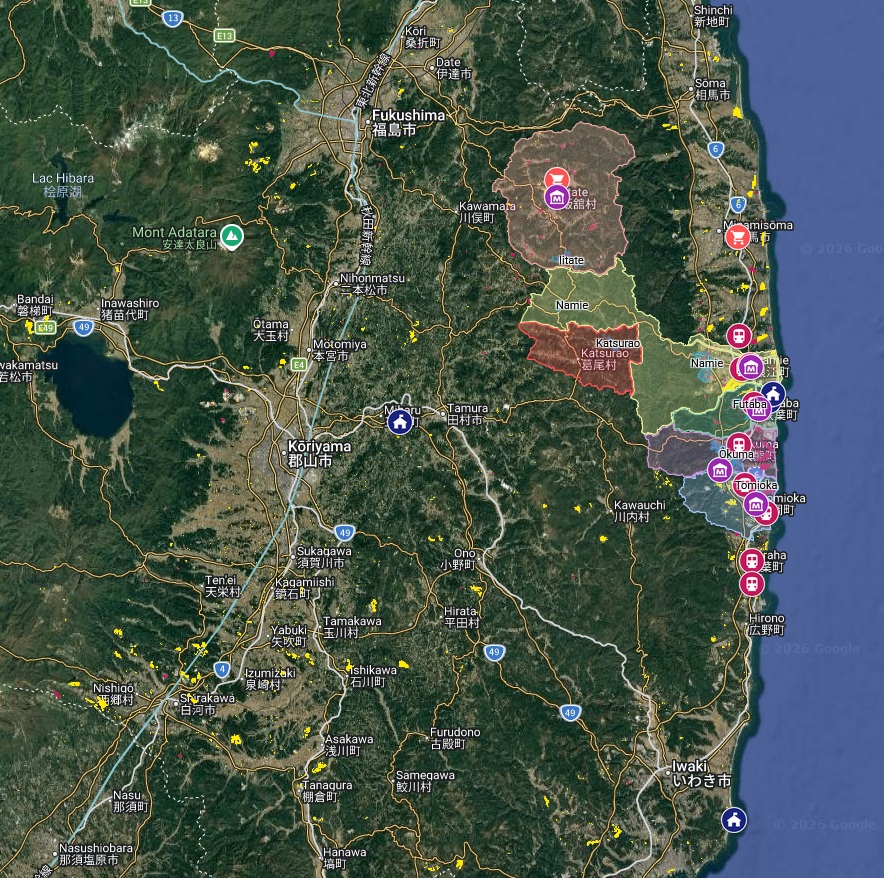
©Mitate Lab. Map drawn by Cécile Asanuma-Brice (CNRS), Jérôme Arnaud (Unistra)
DOI 10.5281/zenodo.7796792
Link to the interactive map : https://www.google.com/maps/d/edit?mid=1Q76yTK7MvsZJAp0upSSVJWnytSqLYZrg&ll=36.90970501840381%2C140.74981481052518&z=16
The associated datasets are available here : https://zenodo.org/record/7796792#.ZCv0ty8itsF